
News
Port Metro Vancouver selects JASCO to help mitigate vessel noise impact on marine mammals in British Columbia
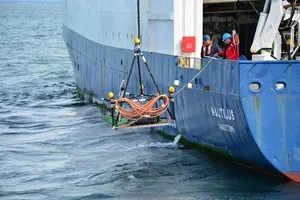
JASCO Applied Sciences (Canada) Ltd has been selected by Port Metro Vancouver and Ocean Networks Canada to provide real-time passive acoustic monitoring of vessel traffic in the Strait of Georgia, BC, Canada, in order to study the potential impacts of shipping noise on marine mammals.
Two listening stations—each comprised of an AMAR Observer with a small spatial array of hydrophones and an AMAR Projector—were deployed on the major shipping route to Vancouver. These two systems are connected to shore in real-time via Ocean Networks Canada’s VENUS fibre optic cabled subsea observatory, which allows people and automated systems ashore to listen, measure, and characterize underwater sounds in the Strait of Georgia in real-time. AMAR Projectors calibrate and test the receiving arrays and will be useful in future planned experiments in underwater communications and navigation. These listening stations form part of the Enhancing Cetacean Habitat and Observation (ECHO) Program.
Real-time underwater sound monitoring of Bay of Fundy tidal berth sites
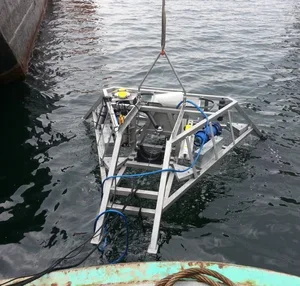
JASCO has begun monitoring and measuring underwater sound at the Fundy Ocean Research Center for Energy (FORCE) tidal energy berth sites in the Bay of Fundy, Parrsboro, Nova Scotia.
The cabled monitoring system, designed and assembled in Dartmouth, Nova Scotia, is “world-leading ocean technology that helps protect our marine environment,” said Scott Carr, CEO of JASCO Applied Sciences. It is deployed on FORCE’s Fundy Advanced Sensor Technology mini-platform, an underwater framework that captures data from the site with onboard sensing equipment. “To harness the enormous power of the Bay of Fundy responsibly, we have to understand it. The FAST platforms give us a clearer, moment-by-moment picture of what’s happening under the water,” said FORCE general manager Tony Wright.
An AMAR to study harbour seal calls
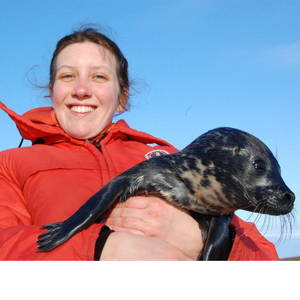
Kat Nikolich, a Western Washington University (WWU) graduate research student, is collaborating with JASCO Applied Sciences to deploy one of its Autonomous Multichannel Acoustic Recorders (AMARs) this summer to measure the vocal repertoires of harbour seals (Phoca vitulina) breeding in the northern Strait of Georgia, BC. Nikolich, who is completing a master’s degree in biology, will work with JASCO bioacoustics expert and pinniped specialist Dr. Héloïse Frouin-Mouy.
The specialized acoustic recorder will be anchored to the seabed near one of the largest seal haul-outs in the region, on the south shore of Hornby Island. The device will record sounds continuously from June through September, spanning the full breeding season of the seals. At the same time, a research team from WWU, comprised of a dedicated team of undergraduate students led by Kat, will observe the seals’ activity from the shore nearby.
AMAR mission to VENUS
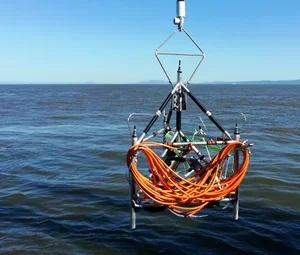
JASCO Applied Sciences has deployed since early March two of its AMAR underwater sound monitoring systems on the VENUS underwater observatory for a technology demonstration and data gathering mission planned to last several months. VENUS (Victoria Experimental Network Under the Sea) is a cabled ocean observatory, in the Salish Sea coastal waters of British Columbia, operated by Ocean Networks Canada.
JASCO’s AMARs have been deployed at two locations on the VENUS Ocean Observatory in the Strait of Georgia. The primary purpose of this mission is to demonstrate the multi-sensor data collection and streaming capability of the AMAR. Of specific interest to scientists are the real-time detection, identification and localization of calls from individual Southern Resident Killer Whales, and the measurement of the underwater noise from vessels to which these animals may be exposed
JASCO delivers bioacoustics training course at DFO research centre
JASCO scientists Julien Delarue and Marie-Noël Matthews delivered a 2-day course on bioacoustics to 15 researchers and resource managers from the Department of Fisheries and Oceans (DFO) at the Maurice Lamontagne Institute in Mont-Joli, QC on 20-21 March 2014. The course included modules on:
Acoustic fundamentals
Sound propagation modelling
Effects of anthropogenic noise on marine life
Mitigation and modelling of underwater sound
International regulatory frameworks for underwater sound
Acoustic monitoring programs and equipment
Case studies from JASCO’s diverse project portfolio
JASCO Team wins Brain War 2014
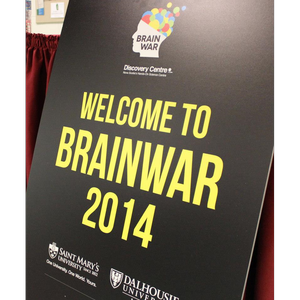
The “JASCO Sound Crew” placed first out of 37 teams at the inaugural competition of Brain War, a fundraising event for the Discovery Centre held Saturday February 22 at Halifax’s Saint Mary’s University. The team consisting of Terry Deveau, Mikhail Zykov, Christopher Whitt, and Nicole Chorney competed in a 6 hour marathon of brain-straining challenges that tested their knowledge in science, technology, engineering, art, and math.
The JASCO team went on to win against the four other highest ranking groups at the February 27 Gala event and final where they faced off on stage in front of peers and spectators and won the championship trophy. The Gala was hosted by CBC News Nova Scotia host Tom Murphy and CBC Mainstreet's Stephanie Domet.
1 year of wide-area acoustic monitoring in the Falkland Islands
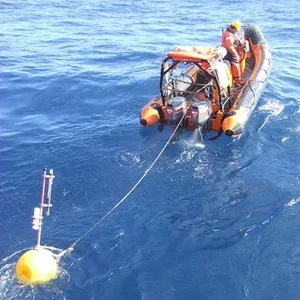
JASCO completed a wide-area, 1-year static acoustic monitoring program in the Falkland Islands as part of a broad Environmental Impact Assessment undertaken by Rockhopper Exploration / Premier Oil. This extensive recording program was conducted in the challenging South Atlantic Ocean in 450 m of water and provided continuously recorded, wideband acoustic data to assess marine mammal diversity and temporal variability in presence throughout the year.
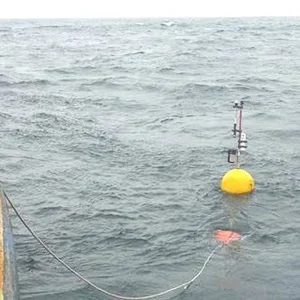
Offshore piling noise recorded with catenary-based floating AMAR
JASCO completed a complex, offshore piling noise recording program for BP, west of Shetland. Sound from piling activity to install a large platform jacket was recorded at a number of static and mobile recording locations using a series of JASCO’s AMAR G3s (Autonomous Multichannel Acoustic Recorders).