A new call to action from OCEANOISE on World Ocean Day
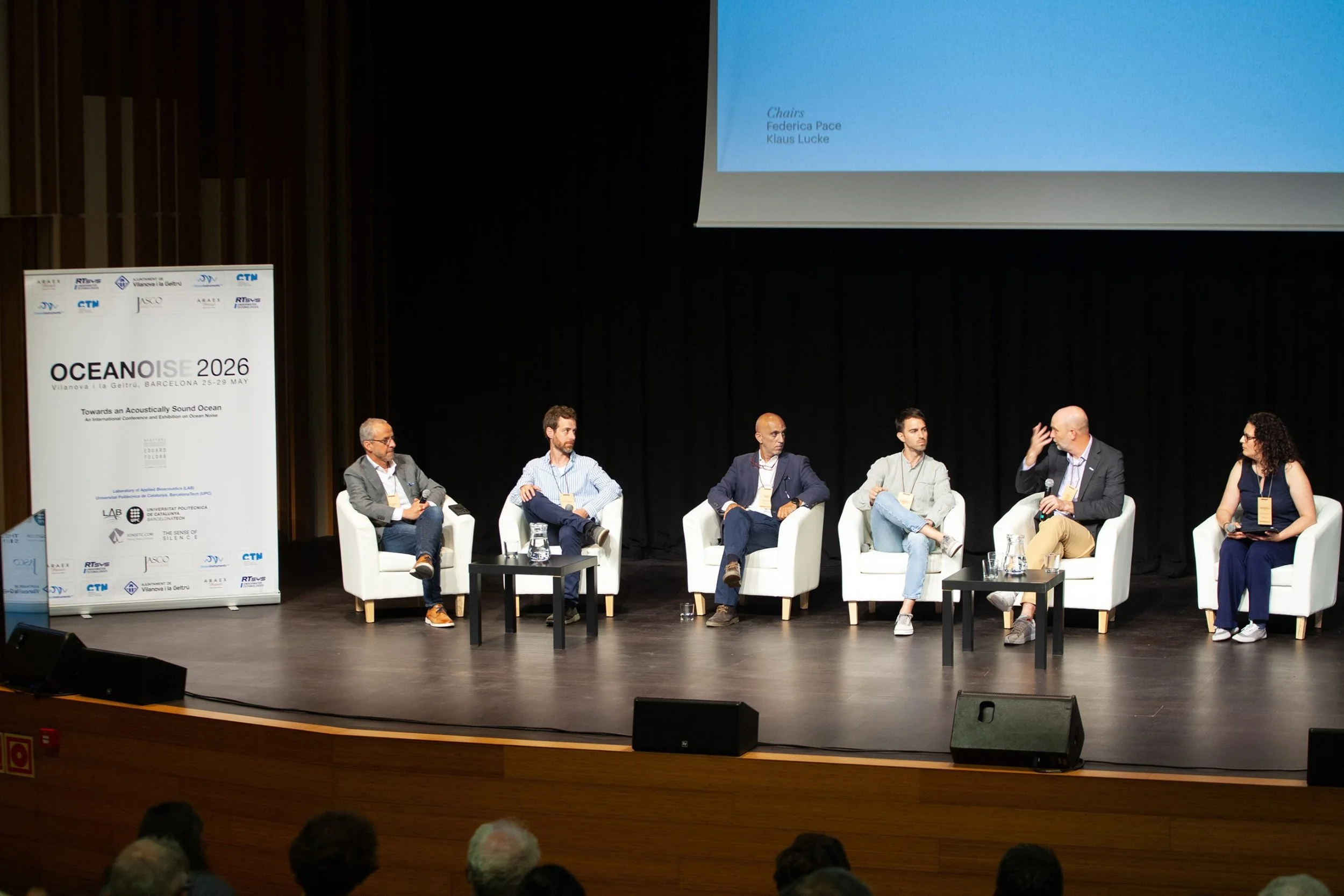
An OCEANOISE session round table
The fourth edition of the OCEANOISE conference series took place on the last week of May 2026 in Vilanova i la Geltrú, Spain. Scientists from JASCO Applied Sciences participated by invitation, as session chairs or speakers and panelists, in this triennial event which brings together international stakeholders from the worlds of research, regulation and industry to address critical issues of assessment and mitigation of underwater noise impacts on ocean life.
In the model of earlier editions, on the closing day of the conference an expert panel engaged with the audience in a plenary discussion of the key points that had emerged from the prior four days of talks and presentations. Co-moderated again by conference chair Michel André and JASCO’s Chief Communications Officer, Roberto Racca, the discussion opened with a review of key questions and issues that had emerged from the technical sessions and how the ocean acoustics community should address them. The conversation then shifted to a set of actionable recommendations identified by members of the Science Advisory Committee as meaningful steps toward global implementation of effective technologies and regulations aimed at reducing human produced noise in the oceans.
Like at the previous OCEANOISE conference in 2023, it was agreed to issue a global call to action stressing the urgent need for a coordinated response. The following declaration was subsequently composed and endorsed by the Advisory Committee and made public on 8 June, World Ocean Day.
“OCEANOISE2026 DECLARATION: A Call for Immediate Action on Ocean Noise
As representatives of science, industry, government agencies, civil society and environmental organisations committed to the future of the ocean, we issue this call for action to decision-makers worldwide.
From 25 to 29 May 2026, experts from around the world gathered in Vilanova i la Geltrú, Spain, for the fourth edition of OCEANOISE, the international conference dedicated to understanding and addressing the impacts of human-generated sound on marine ecosystems. The scientific evidence presented leaves no room for doubt:
Ocean noise cannot be considered a marginal environmental issue. It is a systemic environmental challenge to the health and resilience of our oceans. It must be addressed as a core component of ocean governance.
The ocean is not a silent world.
For all marine species, sound is the primary sense through which they perceive their environment. Marine animals use sound to communicate, navigate, locate food, avoid predators, find mates and maintain the ecological connections upon which entire ecosystems depend. In other words, life in the ocean depends on sound. It does not adapt to sound as a secondary signal — it is structured around it.
Yet while environmental assessments routinely consider chemical pollutants, habitat degradation and water quality, the acoustic dimension of human activities remains largely overlooked.
This omission is no longer scientifically defensible.
Evidence presented at OCEANOISE 2026 confirms that underwater noise affects a wide range of taxa, including fish, invertebrates and planktonic organisms, with consequences that may propagate across the entire food web. The challenge is therefore not limited to individual species sensitivity, but concerns Ecosystem Functionality, Biodiversity Resilience and Ocean-dependent economies.
Addressing underwater noise requires moving from a species-centric perspective to an ecosystem-based management approach.
At the same time, a new generation of ocean industries is rapidly emerging. Deep-sea mining, offshore renewable energy, autonomous vehicles, large-scale underwater sensor networks, acoustic communications and the future “Underwater Internet of Things” are being developed at unprecedented speed. Many of these technologies rely directly or indirectly on the transmission of sound through the ocean.
Without a structured framework for acoustic management, cumulative impacts will increase faster than our ability to assess or mitigate them. This creates a clear need for anticipatory governance, not reactive correction.
OCEANOISE therefore calls upon governments, regulatory authorities, international organisations, financial institutions, technology developers and industry leaders to adopt the following principles:
1. Make acoustic impact assessment mandatory from the earliest stages of development
Any current or prospective activity, infrastructure, operation or technology intended to operate in or affect the marine environment must include an assessment of its acoustic footprint from the earliest stages of design, planning and approval.
Sound must no longer be treated as an incidental by-product or a secondary environmental consideration. Just as carbon emissions, water quality and habitat degradation are evaluated before projects proceed, acoustic impacts must become a standard component of environmental governance.
Hence, acoustic impact assessment should be systematically integrated:
• At the design stage (ships, infrastructures, technologies)
• Within environmental impact assessments
• Across operational decision-making
What cannot be quantified cannot be effectively managed.
2. Apply precaution to emerging ocean technologies
Emerging ocean technologies and new industrial activities should demonstrate acoustic performance and responsibility for emitted sound and vibrations prior to large-scale deployment. This principle is particularly relevant for emerging activities such as deep-sea mining, large-scale acoustic communication systems, autonomous underwater networks and future underwater digital infrastructures. The absence of complete scientific certainty must not be used as a justification for postponing preventive measures.
Precaution must be operationalised through measurable criteria, not only stated as a principle.
3. Protect the Full Spectrum of Marine Life and Ecosystem Processes
Environmental assessments must consider the effects of sound and vibration on all levels of marine ecosystems. Protection cannot be limited to marine mammals or species already recognised as vulnerable.
Scientific evidence increasingly shows that sound affects a broad diversity of marine organisms. Because of the interconnectedness of ecosystems, impacts on any group of species may trigger cascading effects throughout food webs and ecological processes. Reduction of human noise in marine ecosystems is demonstrably possible at local and regional scales through technology and operational measures. This can and should be advanced through both regulation and incentivization.
4. Recognise sound as a fundamental component of Ocean Health
Sound should be recognised internationally as a core environmental variable for assessing and managing Ocean Health. A healthy ocean is not only chemically and biologically balanced. It is also acoustically functional.
Protecting the ocean’s acoustic environment is therefore essential to protecting biodiversity, ecosystem services and humanity’s relationship with the sea.
There is reason for optimism. Unlike many forms of pollution, ocean noise can be reduced immediately. When a source of noise is mitigated, modified or switched off, its impact can diminish instantly. This makes ocean noise one of the environmental pressures for which rapid and measurable improvements are achievable.
The solutions exist. The technologies exist. The scientific knowledge exists. What is now required is the collective determination to act. The ocean cannot speak for itself. Its soundscape is its voice, and we must listen to it.
Protecting that voice is one of the defining environmental responsibilities of our time.”
About JASCO Applied Sciences
JASCO Applied Sciences is a world leader in the science of underwater sound and its effects on marine life. A global company founded in Victoria, Canada, in 1981, JASCO provides services from offices in Canada, the United States, the United Kingdom, the Netherlands, Germany, and Australia. We provide support for all stages of environmental reviews and assessments of underwater sound for the renewable energy, oil and gas, marine construction, shipping, and defence sectors. We design, develop, and manufacture state-of-the-art oceanographic data acquisition systems to meet project demands for quality, endurance, reliability, and performance. We enable our clients to satisfy regulatory requirements by providing scientifically defensible assessments of their projects to government regulators and the public. For more information, visit: www.jasco.com.