Hearing in the Dark
In their article titled Hearing in the Dark in the Deep Sea special issue of ECO Magazine (Environment, Coastal and Offshore), Roberto Racca and Klaus Lucke of JASCO Applied Sciences take you on an abyssal journey from a deep-water scientific research mooring in the Gulf of Mexico to bizarrely beautiful fish life in the Indian Ocean.
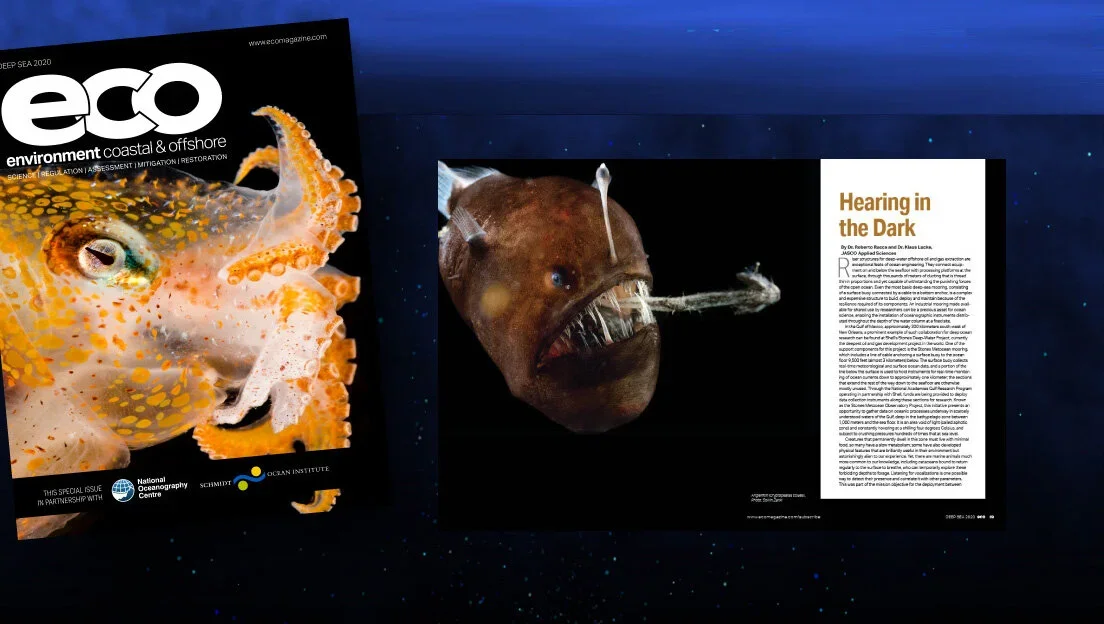
From the article:
In the Gulf of Mexico, approximately 300 kilometers south-west of New Orleans, a prominent example of collaboration for deep ocean research can be found at Shell’s Stones Deep-Water Project, currently the deepest oil and gas development project in the world. One of the support components for this project is the Stones Metocean mooring, which includes a line of cable anchoring a surface buoy to the ocean floor almost 3 kilometers below. Under the Stones Metocean Observatory Project partnership, funds are being provided to install at the mooring oceanographic instruments for research. During 2019 two JASCO AMAR landers were deployed on the seafloor at the site to collect the first deep water recordings of soundscape in the Gulf of Mexico. The recorders documented sounds associated with shipping, distant seismic survey impulses, the nearby oil and gas floating production facility, and three marine mammal species groups. There is indeed plenty to listen to at the bottom of the sea.
But what deep oceanic species are there that can hear these sounds? Life in the depths is adapted to wholly different conditions than exist near the surface, with increasingly high static pressure and decreasing or no light. Here, animals create their own light through bioluminescence. What of their hearing abilities? To understand how deep-sea animals such as fishes perceive their environment through a variety of sensory mechanisms, a group of Australian experts joined an international research expedition in the Indian Ocean onboard the German research vessel (RV) Sonne. The question was whether deep-sea fish have a keener sense of hearing compared to their shallow-water counterparts.
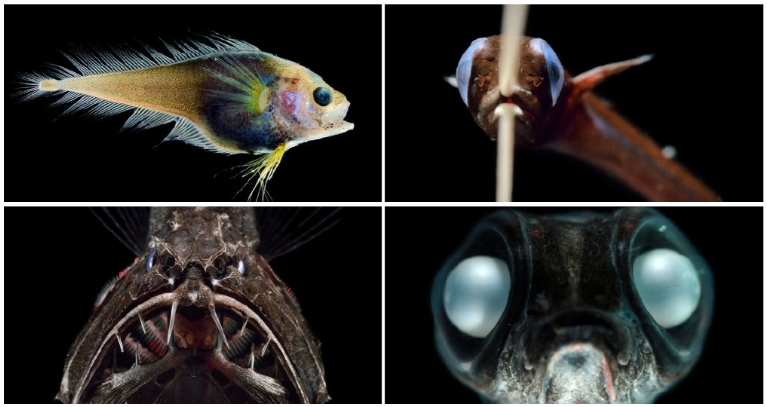
Fishes of the deep - Some amazingly adapted deep-water species, in the brilliant photography of Solvin Zankl.
This special issue, in the words of ECO senior editor Kira Coley, does “descend into the deep ocean and reveal what we now know about extreme life and ecosystems, deep-sea observations, innovation in the depths, and the impact of humans in the deep.“
Read the full article or browse the entire Deep Sea special issue.
About JASCO Applied Sciences
JASCO Applied Sciences is a world leader in the science of underwater sound and its effects on marine life. A global company founded in Victoria, Canada, in 1981, JASCO provides services from offices in Canada, the United States, the United Kingdom, the Netherlands, Germany, and Australia. We provide support for all stages of environmental reviews and assessments of underwater sound for the renewable energy, oil and gas, marine construction, shipping, and defence sectors. We design, develop, and manufacture state-of-the-art oceanographic data acquisition systems to meet project demands for quality, endurance, reliability, and performance. We enable our clients to satisfy regulatory requirements by providing scientifically defensible assessments of their projects to government regulators and the public. For more information, visit: www.jasco.com.